CLIMATEEDICT #11: A SPECIAL EDITION — THE MONTHS WE MISSED
Opening Reflection
I have been away for a while. Not because I stopped caring, but because I could not find the time to put any of this into words. Life kept moving, and the blog went quiet. The planet did not. While I was caught up in everything else, records were broken, treaties were finalized, and scientists confirmed things many of us had feared for years but had never quite been able to prove so clearly. So this is a catch-up edition. Not a rushed summary, but a real return. These are the stories that mattered since December. Some of them are difficult to sit with. Some seem quiet at first, then stay with you. That is what this blog has always been for, trying to look at the full picture, even when part of it is painful.
The Ocean Just Had Its Hottest Year on Record. Again.

A major international study published in January 2026 confirmed that the world’s oceans stored more heat in 2025 than in any year since modern measurements began. The increase was roughly 23 zettajoules compared to 2024, which is about 210 times humanity’s total annual electricity generation. The study involved more than 50 scientists across 31 research institutions worldwide.
Ocean heat content broke its record for the ninth consecutive year in 2025. That makes this the longest streak of consecutive ocean heat records ever observed. That is not random, and it is not a fluke. It is one of the clearest signals the climate system gives us, steadier and more reliable than any single surface temperature reading, any one storm, or any one year.
A warmer ocean creates warmer, wetter air, and that makes storms stronger. Scientists have described it as weather on steroids, more extreme, more unstable, and harder to predict. In 2025 alone, this helped drive catastrophic floods in Texas, monsoon deaths across South and Southeast Asia, and devastating wildfires in Canada. The ocean absorbed that energy first, and the rest followed
What stays with me most is the scale of that number. Twenty-three zettajoules does not feel real until you place it next to something human. The ocean absorbed that much extra energy in a single year while I was studying, writing essays, and trying to make sense of my own future. And it will keep rising until emissions reach zero. The science on that is simple. Living with what it means is not.

The Worst Coral Bleaching Event in History Is Still Going
A new study published in the journal Coral Reefs in January 2026 confirmed what many scientists had been worried about. The fourth global bleaching event, which began in early 2023, has still not ended. The study found an uninterrupted and ongoing period of global coral heat stress from 2018 to 2025, affecting an unprecedented 87% of reef areas globally. On average, the intensity of that heat stress was nearly 50% greater than during the previous record bleaching event.
The numbers show a pattern that is getting harder and harder to ignore. During the first global bleaching event in 1998, 21% of reefs experienced bleaching-level heat stress. That rose to 37% in 2010, then 68% during the 2014 to 2017 event. Now we are past 84%. Every event was described as unprecedented at the time. Every one was worse than the last. There is no reason to think that pattern changes unless temperatures do.What changed this time was not just the damage, but the way scientists had to track it. A widely used bleaching prediction platform had to add three new alert levels, Levels 3 through 5, to its Bleaching Alert Scale because the old one was no longer enough. Level 5 indicates the risk of more than 80% of all corals on a reef dying due to prolonged bleaching. In effect, scientists had to expand the scale because the reality had moved beyond what it was built to measure.
I have cared about reefs since I started this blog. The science always felt urgent. Now it feels close to irreversible if nothing changes. Coral reefs support roughly a quarter of all known marine species. They protect coastlines. They support entire fishing economies. And scientists are now openly asking whether ocean temperatures will ever fall below the bleaching threshold again.
The High Seas Finally Have Legal Protection
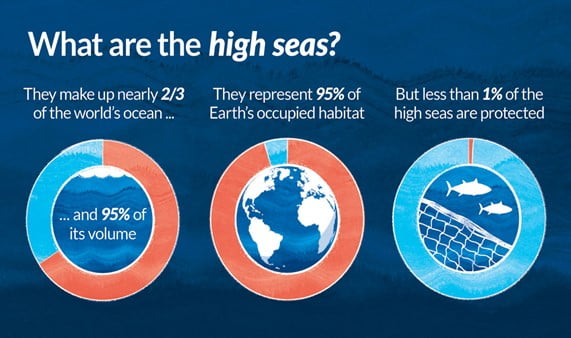
This is the story I most wanted to write. After nearly 20 years of negotiations, the High Seas Treaty officially entered into force on 17 January 2026. For the first time, there is now a legal framework to protect biodiversity in international waters and to ensure the benefits of their resources are shared more fairly among nations.
The high seas cover roughly half the surface of the planet. Before this treaty, they were governed through a patchwork of regional fisheries agreements, shipping conventions, and scattered protected areas that covered less than 1% of the high seas. That left enormous gaps for marine biodiversity. At least on paper, that gap has now been addressed. The treaty creates a path for marine protected areas in international waters, requires environmental impact assessments for ocean development, and includes provisions for sharing benefits from marine genetic resources more equitably across countries.There is still real work ahead. The first Conference of Parties has to establish governance structures, funding systems, and ways to monitor implementation. The United States has signed but not yet ratified. Not every country will apply this with the same seriousness. Still, the framework now exists. International waters, which were effectively beyond meaningful biodiversity protection for far too long, now fall under a binding treaty backed by more than 80 ratifying countries.
Progress like this rarely feels dramatic. It is slow, technical, and often hidden inside years of negotiation rooms, revisions, and compromise. But it is real, and it matters. In the long run, it may matter more than almost any louder headline from the same period. This is what environmental progress often looks like when it finally arrives.
Warming Has Nearly Doubled Its Pace Since 2015
This is the newest finding in this edition, and probably the most important. On 6 March 2026, researchers at the Potsdam Institute for Climate Impact Research published a study in Geophysical Research Letters with a number that deserves attention. Over the past ten years, the estimated warming rate has been around 0.35°C per decade, compared with just under 0.2°C per decade on average from 1970 to 2015. That is the highest rate recorded in any decade since instrumental measurements began in 1880.
What matters even more is how the researchers reached that result. They removed the natural noise, El Niño cycles, volcanic eruptions, solar variation, all the usual factors people point to when they want to blur the trend. Once that noise was stripped away, the acceleration remained. It appeared clearly and consistently, with more than 98% statistical confidence across five independent datasets. This is not a story about weather. It is a story about direction. If the warming rate of the past ten years continues, it would lead to a long-term exceedance of the 1.5°C Paris Agreement limit before 2030.That timeline runs straight through everything else in this edition. Faster warming means oceans taking up heat faster. It means more bleaching, with less and less time for reefs to recover between events. It means storms drawing strength from hotter water. For anyone paying attention to ocean health, this is not a separate issue. It is the process behind all the others.The lead author of the study made one point very clearly. If humanity reaches net-zero emissions, further warming can be stopped. The science does not say action no longer matters. It says the space between where we are and where the limits sit is shrinking fast.
Closing Reflection
Coming back to this after months away, what strikes me most is how much happened without a single dramatic turning point. There was no one moment that changed everything. Just these four stories, published within a few months of each other, each showing in its own way that the system is under real and measurable strain.But the High Seas Treaty is real. It took twenty years, and now it is international law. That matters. It shows what long, patient, often thankless work can still produce. And the lead author of the warming study was clear that the outcome still depends on whether ambitious action is taken. That sentence matters too, because it means the story is not over.I want to keep writing this because paying close attention still feels like the right place to begin. Not awareness for its own sake, but because looking honestly at the full picture, the records, the treaties, the damage, the commitments, is the only way to stay honest about where we are. I do not want to go quiet again for this long.
Sources
Ocean heat record: https://news.mongabay.com/2026/01/ocean-set-alarming-new-temperature-record-in-2025/
Coral bleaching update: https://link.springer.com/article/10.1007/s00338-025-02810-x
High Seas Treaty entered into force: https://highseasalliance.org/2026/01/16/historic-high-seas-treaty-enters-into-force-launching-a-new-era-of-global-ocean-governance/
Warming acceleration study: https://www.pik-potsdam.de/en/news/latest-news/significant-acceleration-of-global-warming-since-2015


Comments
Post a Comment